
Tools and New Possibilities
The evolution of audio production is entering a new chapter. As immersive formats gain momentum in music, film, gaming, and virtual reality, the way creators think about sound is changing. Increasingly, engineers and producers are looking beyond traditional loudspeaker setups and turning their attention to headphones, the most widely used listening medium worldwide.
Mixing immersive audio with headphones, however, presents unique challenges. Unlike conventional stereo or surround workflows, it demands a balance of acoustic science, spatial perception, and technological precision. The goal is not only to reproduce sound, but to recreate the experience of being surrounded by it, translating complex multichannel loudspeaker mixes into a plausible virtual headphone environment.
By combining decades of psychoacoustic research and modern innovation in binaural rendering and head tracking, tools like Okeanos Pro make it possible to experience immersive, multichannel sound over headphones as if they are coming from real loudspeakers.
The Shift from Loudspeakers to Headphones
In traditional loudspeaker-based mixing, engineers rely on natural acoustic cues: the way sound interacts with the room, reflections that create a sense of depth, and the spatial blending of multiple sources to form an immersive sound field. These cues help the listener perceive sound sources as externalized and positioned within a three-dimensional space. Headphone playback, however, delivers separate signals to each ear. This isolation can cause sounds to be perceived as originating “inside the head,” rather than in the surrounding environment.
Recent research in spatial audio shows that integrating accurate room characteristics, head related filters and dynamic cues, such as head movement and virtual loudspeaker directivity, significantly enhances the realism of headphone-based listening. With the right tools and techniques, it’s possible to achieve an experience so convincing that virtual loudspeakers become nearly indistinguishable from real ones.
Enhancing Perception and Realism
The key to convincing immersive headphone mixes lies in how the brain interprets auditory cues. Factors like head movements, interaural time and level differences, and the subtle filtering of sound by our head, ears, and torso all play a role. Systems that take these cues into account provide the most natural experience.
A 2024 study by Brandenburg Labs’ team states that when accurate head tracking and room simulation are combined, listeners perceive headphone-rendered sound sources as external and stable in space, not “inside” the head. This opens new creative possibilities for music producers, game developers, and audio educators who want to explore spatial sound without requiring a complex loudspeaker setup.
Building the Right Workflow – Our solution
Transitioning from stereo or surround mixing to immersive headphone workflows begins with a reliable monitoring system. Engineers require headphones with a neutral frequency response and a calibrated binaural renderer capable of accurately simulating multichannel loudspeaker setups.
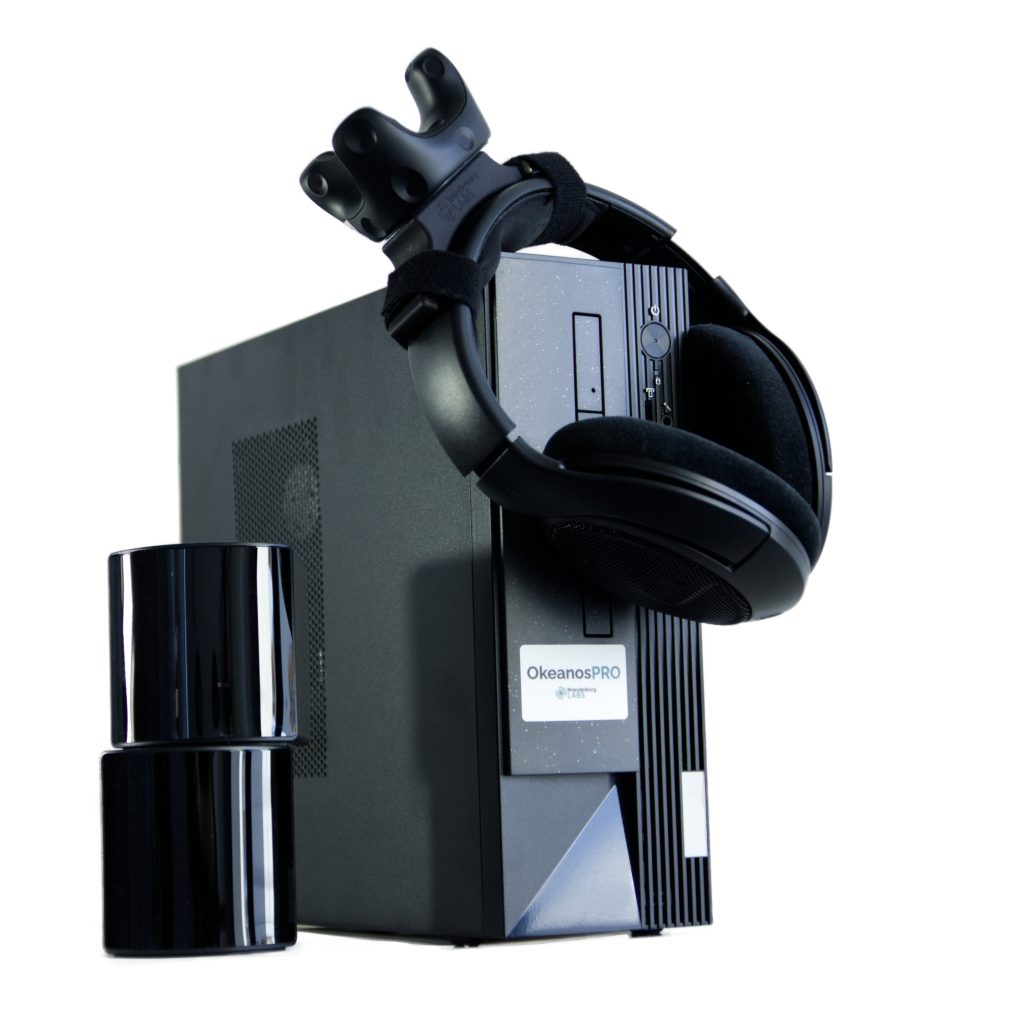
Brandenburg Labs’ Okeanos Pro stands out as a professional tool for immersive audio monitoring. The system allows engineers to experience multichannel mixes over headphones with an unparalleled level of realism. Upon initial setup, Okeanos Pro adapts to the acoustic characteristics of the listening space and responds dynamically to the user’s head movements using Six Degrees of Freedom (6DoF) head tracking. This allows the simulation and exploration of important characteristics of real loudspeakers (such as their directivity) and the making of critical decisions for the mix.
A recently introduced key feature of Okeanos Pro is its Directivity Transfer Function (DTF) technology, which models the unique acoustic behavior of each virtual loudspeaker. Users can record and edit DTFs at six cardinal positions: front, back, left, right, top, and bottom, with interpolation at 10° intervals to achieve full 360° coverage. A built-in library of pre-made DTFs also supports faster setup and experimentation.

By combining precise binaural rendering, real-time 6DoF head tracking, and room-aware simulation, Okeanos Pro bridges the gap between research and practical application. It empowers engineers, educators, and creators to explore immersive sound with accuracy, consistency, and flexibility, via headphones.
Want to try music mixing with Okeanos Pro yourself? Visit us at one of our upcoming events or sign up for a demo at sales@brandenburg-labs.com.
Resources
Best, V., Baumgartner, R., Lavandier, M., Majdak, P., & Kopčo, N. (2020). Sound Externalization: A Review of Recent Research. Trends in hearing. https://doi.org/10.1177/2331216520948390
Riionheimo, J., & Lokki, T. (2024). Spatial Sound, Part 1: Exploring the Impact of Listening Room on Perceptual Immersion. Journal of the Audio Engineering Society. https://doi.org/10.17743/jaes.2022.0179
Sloma, U., Merten, N., Thron, T., Brandenburg, K., Wollwert, F., Profeta, R., & Rodriguez, C. (2023). Proof of concept of a binaural renderer with increased plausibility. In 49th Annual Meeting for Acoustics (DAGA 2023). https://pub.degaakustik.de/DAGA_2023/data/articles/000185.pdf
Sloma, U., Thron, T., Merten, N., & Brandenburg, K. (2024). Multichannel immersive audio demo with reduced number of RIR measurements. In 50th Annual Meeting for Acoustics, DAGA, Hannover, 2024. https://pub.degaakustik.de/DAGA_2024/files/upload/paper/612.pdf