


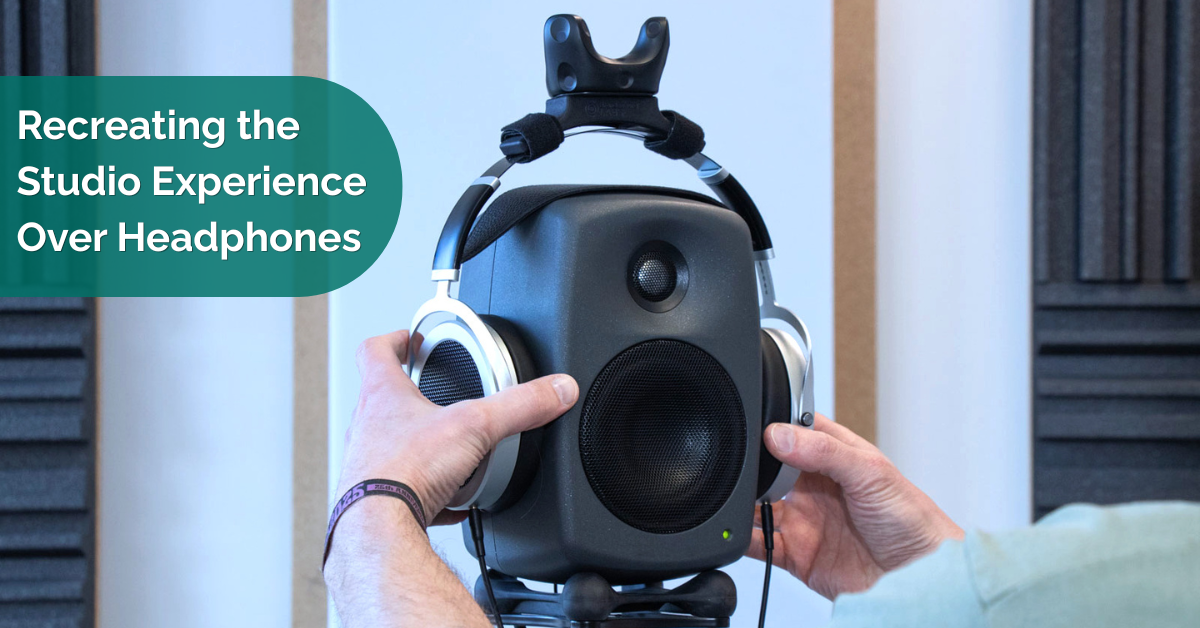
Recreating the Studio Experience Over Headphones: Can Headphones Replace a Studio?
For decades, professional audio production has relied on loudspeaker-based monitoring in acoustically designed rooms. Whether mixing music, producing immersive content, or teaching audio engineering, the studio has been the reference environment for making critical listening decisions.
At the same time, headphones have become an integral part of our daily lives and have evolved from their early designs into essential tools in both casual and professional audio applications. With the emergence of digital audio formats like MP3, headphone technology has advanced significantly, enhancing accessibility and listening quality.
In a previous blog we explored the basics of headphones and their role in spatial audio. Building on that foundation, this article looks at how advancements in audio technology are changing the relationship between headphones and traditional studio environments, and how the gap between the two concepts continues to narrow.
What makes a studio valuable?
A professional studio provides more than high-quality loudspeakers; it also provides a controlled acoustic environment. The size of the room, the placement of the loudspeakers, the reflections from walls and surfaces, and the listener’s position all contribute to how sound is perceived. These factors help sound engineers make informed decisions about balance, localization, depth, and immersion. This is also one reason why studios require careful acoustic design and calibration.
Why headphones became essential
Headphones are portable and require little space. Most importantly, they provide a consistent listening experience.
For tasks such as editing, monitoring details, and checking recordings, headphones have long been a standard tool in professional workflows. However, conventional headphones also have limitations. Because sound is reproduced directly at the ears, listeners do not experience the same interaction between loudspeakers, room acoustics, and head movements that occur in a studio environment. Therefore, evaluating spatial relationships, distance, and immersion can be more challenging compared to listening through loudspeakers in a well-designed mixing room.
Bridging the gap – A different approach
Recent developments in immersive audio are helping to narrow the gap between headphone listening and loudspeaker monitoring. Technologies such as head tracking, room acoustic modeling, and virtual loudspeaker rendering make it possible to recreate important characteristics of a studio environment over headphones.
At Brandenburg Labs, this concept forms the foundation of Okeanos Pro, a headphone-based system powered by our core technology, Deep Dive Audio. Okeanos Pro accurately simulates virtual sound in a clearly localized and precise manner in the room and gives the plausible impression of hearing a real loudspeaker system.
Supporting up to 16 virtual loudspeakers, Okeanos Pro enables users to experience and work with immersive audio formats without requiring a dedicated physical multichannel loudspeaker installation. This can make advanced monitoring setups more accessible for educational institutions, research environments, content creators, and audio professionals who may not have access to large or acoustically optimized spaces.
Rather than replacing studios entirely, headphone-based spatial audio systems like Okeanos Pro offer a revolutionary and complementary approach to monitoring and a reference to the studio.
Physical studios remain valuable for many applications, particularly when multiple people need to listen simultaneously or when loudspeaker playback serves as the final reference. At the same time, virtual monitoring systems can reduce space requirements, e.g. in broadcasting vans, increase accessibility, and provide consistent monitoring conditions across different platforms.
As spatial audio technologies continue to advance, headphones are becoming capable of reproducing more of the acoustic cues traditionally associated with loudspeaker-based environments. This opens new possibilities for how audio professionals learn, create, and collaborate.